I spend a lot of my working life talking about Contact Centre as a Service, or CCaaS.
As a pre-sales Solution Architect, my role sits somewhere between understanding what a customer is trying to achieve and working out how technology can realistically help them get there. That means getting into the detail of requirements, analysing use cases, shaping solution architecture, running discovery sessions and demos, identifying assumptions and dependencies, estimating delivery effort and ultimately helping turn all of that into something that can form the basis of a Statement of Work.
And one thing I've learnt is that successful CCaaS transformation is rarely just about choosing the right platform.
Technology obviously matters. But so do the conversations that happen before a design is finalised, the relationship between the customer and their technology partner, how open everyone is to challenging existing ways of working and, importantly, whether everyone actually agrees on the outcomes they're trying to achieve.
One area of CCaaS that I personally love is intelligent routing and the wider orchestration around the customer journey.
Not simply getting a contact from A to B, but using context, data, intent and automation to make better decisions about what happens next. Does this interaction actually need an agent? If it does, who is best placed to handle it? What context can we give them? And what can we automate around that conversation to make the experience easier for both the customer and the employee?
For me, that's where CCaaS becomes much more interesting than simply replacing a contact centre platform. You're starting to rethink the experience.
But that's my view from the Solution Architecture side.
I wanted to hear from the people having these conversations with customers long before I start drawing boxes and arrows.
Last week I've caught up with Mat Arnold, Dan Snowdon and Oliver Knowles from TTEC Digital’s Sales Team to find out what they're seeing across CCaaS opportunities right now, where customers sometimes get things wrong, what makes those relationships work and where they see organisations investing.
So not to have written a BOOK instead of a Blog i have chosen to separate their insights into 3 individual blogs.
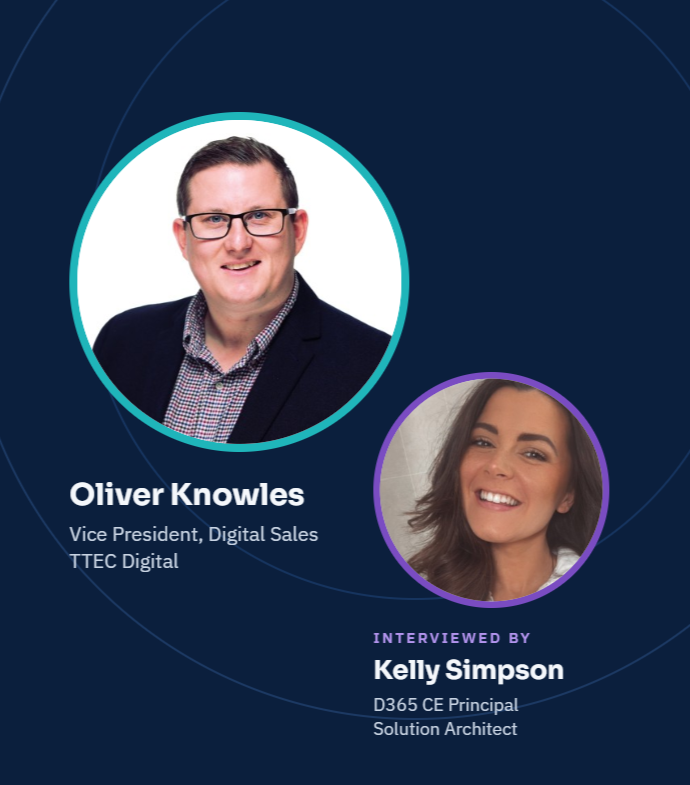
First up is Oliver Knowles, Vice President of Digital Sales at TTEC Digital. Oli brings extensive experience across Microsoft Dynamics 365 and public-sector transformation, with a particular focus on how technology, AI and better-connected experiences can improve outcomes for residents and the people serving them.
What are customers actually asking for from CCaaS right now?
Kelly
One of the interesting parts of pre-sales is that what appears in a requirements document isn't always the same as what becomes important once you actually start talking to the customer. You might see requirements around voice, digital channels, routing, recording, reporting, AI, automation or workforce capabilities, but discovery often starts uncovering the real business problems underneath them.
Across the CCaaS opportunities you're involved in, what are customers talking to you about most at the moment? Have you noticed a change in the conversations customers are having with us or in where they're looking to invest?
Oli
In Local Government, the conversation has moved on from contact centre features to understanding resident or citizen needs. Requirements still include voice, digital, routing, AI and workforce management.
But discovery keeps coming back to three priorities:
First contact resolution: With demand rising, getting it right first time is now a strategic priority.
Inclusion: Councils want to spot vulnerability and additional needs early, so they can adapt the service from the very first interaction.
A connected CRM: The real value comes from a single view of each resident, shown to the advisor or AI assitant at the moment of contact.
Where do customers sometimes set themselves off on the wrong foot?
Kelly
Having worked in delivery in a previous role one of the biggest challenges is when a customer already has a very fixed idea of how something needs to work before we've properly explored why it needs to work that way.
Sometimes there's a perfectly valid reason. Sometimes it's simply, “that's how we've always done it.” That can unintentionally result in recreating yesterday's contact centre on tomorrow's technology.
Where do you see customers making life harder for themselves at the beginning of a CCaaS transformation?
Are there common assumptions, decisions or behaviours that can limit what they ultimately get from the investment?
Oli
Customers sometimes get off on the wrong foot by starting with ambition rather than value. It's easy to build a requirements list around the latest AI, automation and omnichannel capabilities without asking two key questions first:
What will actually make a difference? Every capability should link to a clear outcome, whether that's better first contact resolution, lower avoidable demand or a better resident experience. If it doesn't, it shouldn't be a priority.
Is the organisation ready to deliver it? Technology is only part of the answer. Data quality, CRM integration, processes, skills and change management decide whether outcomes are actually achieved. Without operational readiness, even the best platform will struggle.
My view: high ambition is a good thing, but it needs to sit alongside a practical, phased roadmap. Delivering early, visible wins builds confidence across the organisation and creates the momentum and credibility to take on more advanced capabilities later.
What happens when a customer is too set in their ways?
Kelly
This is one I find particularly interesting as a Solution Architect.
A transformation programme should obviously respect the things that make an organisation unique. But there's a difference between a genuine business requirement and carrying an existing process forward simply because it's familiar.
Sometimes the most valuable conversation we can have is: “Do you actually still need to do it that way?”
How do you approach conversations with customers who are very attached to their existing processes or technology? What helps create enough trust for them to challenge the status quo rather than simply replacing like-for-like?
Oli
If a customer is too set in their ways, they risk rebuilding yesterday's contact centre. Our role is to challenge constructively, show the evidence and make change feel achievable.
What does a really good customer relationship look like during a CCaaS opportunity?
Kelly
Good solutioning is collaborative. The opportunities I enjoy most are the ones where there's enough trust to have an honest conversation. We can challenge an assumption, say when we don't think something adds value and suggest a different approach without it becoming a supplier-versus-customer discussion. That relationship starts well before delivery. From a sales perspective, what separates a strong customer relationship from a purely transactional one during a CCaaS opportunity? And how important are openness, access to stakeholders and the ability to challenge each other constructively?
Oli
A great CCaaS relationship is a true partnership, built on joint ownership, clear accountability, open communication and complete transparency, so we succeed together. . Our success comes from a seamless sales-to-delivery handover and a kick-off that aligns client executives, programme teams and our own people on the same commitments from day one.
How should customers be thinking about ROI?
Kelly
CCaaS business cases can very quickly become feature-led. But implementing more features doesn't automatically equal more value.
For me, the better conversation is what changes as a result. Are we reducing unnecessary contacts? Improving containment? Giving agents better context? Removing repetitive work? Improving customer experience? Making information easier to access? When you're talking to customers about investment and ROI, which outcomes tend to resonate most? And what advice would you give customers on building a business case that goes beyond simply replacing their existing contact centre technology?
Oli
With councils, the outcomes that land best are about residents and demand, not technology:
Higher first contact resolution - fewer repeat contacts, lower cost to serve and more trust from residents.
Better insight - a clear view of why residents get in touch, which helps shape services and policy as well as the contact centre.
Less avoidable demand - more residents can self-serve where that suits them, which frees advisors to focus on complex and vulnerable cases.
Inclusion and early identification of need - spotting vulnerability sooner and supporting residents before their issues escalate into more costly services.
Productivity and resilience - a connected CRM and AI-assisted tools let advisors resolve more, with less effort and less pressure on staff.
Advice on building a stronger business case
A like-for-like replacement case is easy to build but rarely compelling. I'd encourage customers to:
Start with outcomes, not licences - Define the resident and organisational outcomes first, then work back to the capabilities needed to deliver them.
Baseline today's demand - Understand contact volumes, repeat contact and failure demand. That gives a credible starting point for measuring improvement.
Phase the benefits - Link early wins to the first phase and more ambitious benefits to later phases. That keeps the case realistic and builds confidence.
Where are customers investing heavily at the moment?
Kelly
This is where things get particularly interesting because CCaaS is moving beyond traditional contact centre conversations. AI, automation, analytics, self-service, knowledge and agent assistance are becoming increasingly connected to the wider customer experience conversation. The difficult bit isn't finding technology we could implement. It's working out where investment will genuinely make a difference. Where are you seeing the strongest customer interest and investment across CCaaS right now? What areas are generating the most serious conversations, rather than simply curiosity about the latest technology?
Oli
Councils are curious about AI, but the conversations that turn into investment are the practical ones:
CRM and data integration - This is where I see the most serious investment. Councils know the value comes from a single view of the resident, surfaced at the moment of contact.
AI that supports advisors - Tools like real-time guidance, call summaries and knowledge surfacing get real traction because they cut handling time and improve resolution.
Smarter self-service and automation The focus is on handling high-volume, simple requests well, such as bin collections and council tax, so advisors have more time for complex and vulnerable cases.
What makes a CCaaS opportunity go right?
Kelly
We've talked about what can go wrong, but I don't want this to become a list of procurement and transformation horror stories! Some engagements just work. There's clarity, openness, realistic expectations, good access to people and a willingness on both sides to explore possibilities rather than defend positions. Thinking about the CCaaS opportunities that have worked particularly well, what made the difference? What did the customer do that helped sales, pre-sales and the wider team develop a stronger solution?
Oli
In my experience, the best programmes are the ones where customers are aligned internally, bring clear outcomes, real data and the right people, and are open to challenge, so we build the solution together rather than just responding to a spec.
What would you tell a customer before they started their next CCaaS transformation?
Kelly
If I had to give one piece of advice from a Solution Architecture perspective, it would probably be: Tell us the problem before you tell us the answer.
Give us the context, outcomes, constraints and enough room to explore what the best solution could look like.
If you had five minutes with a customer before they started planning their next CCaaS programme, what's the one piece of advice you'd give them?
Oli
Before you agree the technology, agree the outcome. Align your organisation behind it, be honest about your readiness and build a roadmap that proves value step by step
A huge thank you to Oliver Knowles for taking the time to share his perspective. I really enjoyed hearing Oli’s take on this, particularly the focus on starting with outcomes, understanding what will genuinely make a difference and then using technology to get there.
There’s a lot in his answers that resonates with me from the Solution Architecture side too. Transformation works best when we stop asking what technology we can implement and start asking what problem we’re actually trying to solve.
Thanks Oli, some brilliant insights. And next up, we’ll be hearing from Mat Arnold.