Building Is Only the Beginning: Why Application Lifecycle Management Matters in Microsoft Dynamics 365
When organisations invest in Microsoft Dynamics 365 or Power Platform, the focus is often on what the technology will deliver:
Better customer experiences.
More efficient processes.
Improved visibility across departments.
Greater opportunities for automation.
And rightly so, but there’s another conversation that deserves just as much attention’ one that can have a significant impact on the long-term success of a Microsoft implementation.
How do you manage the technology once you start building, changing and evolving it?
Delivering a solution is one thing. Maintaining control of that solution as business requirements change, new functionality is introduced and multiple teams become involved is another challenge entirely.
This is where Application Lifecycle Management (ALM) comes in.
What is Application Lifecycle Management?
Application Lifecycle Management, commonly referred to as ALM, is the structured approach organisations use to manage an application throughout its lifecycle.
From initial planning and development through to testing, deployment, ongoing maintenance and continuous improvement, ALM provides the processes and governance needed to manage change effectively.
Within the Microsoft ecosystem, ALM is particularly important for organisations working with Dynamics 365, Power Apps, Power Automate, Power Pages and Microsoft Copilot Studio.
These platforms give businesses tremendous flexibility to customise and extend their solutions. But with that flexibility comes responsibility.
Without a clearly defined approach to managing changes, organisations can quickly find themselves dealing with inconsistent environments, deployment challenges, unexpected dependencies and increasingly complex maintenance requirements.
ALM helps introduce the structure needed to prevent those challenges from becoming business problems.
Microsoft provides a range of capabilities to support ALM across Dynamics 365 and Power Platform.
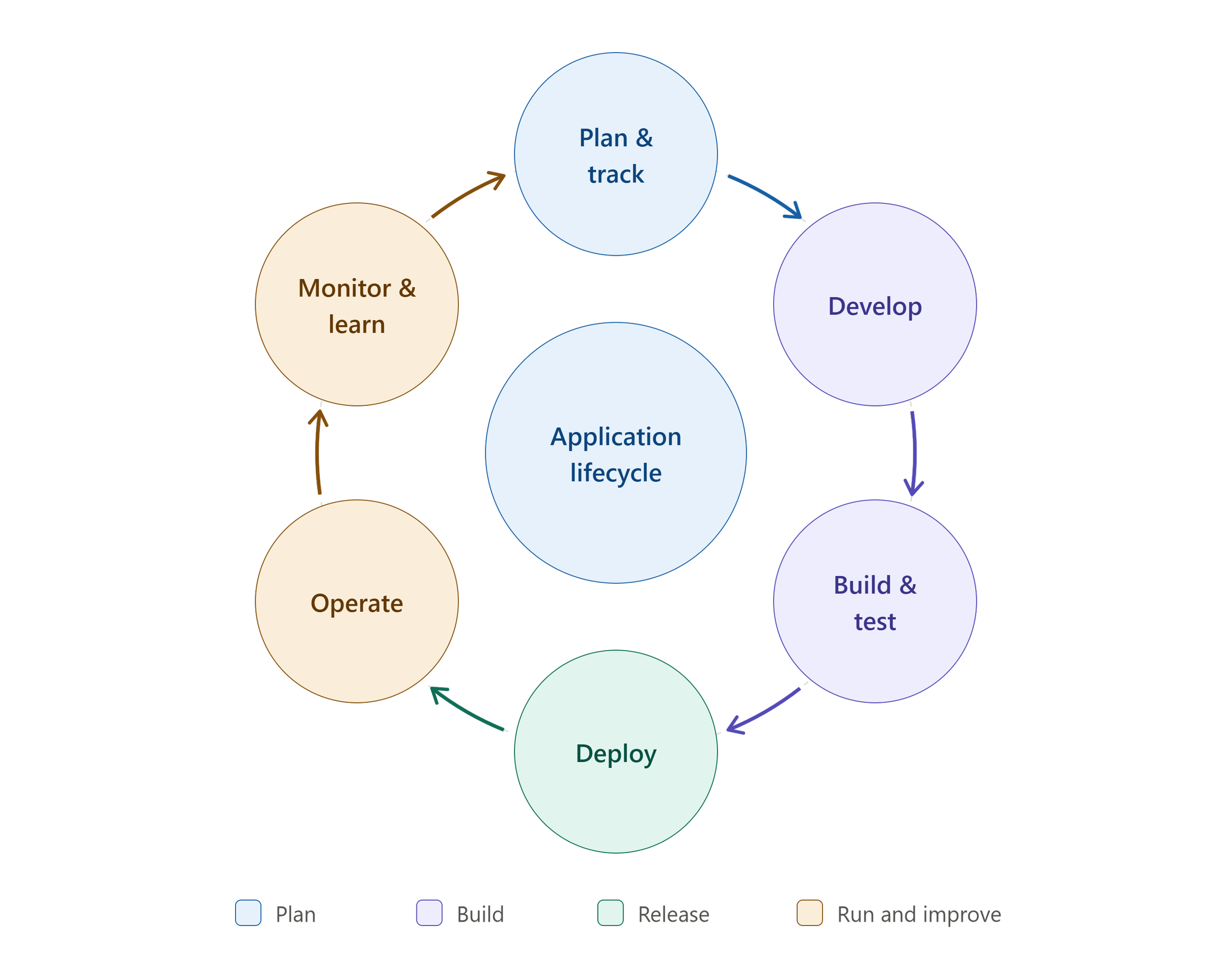
At a high level, the process follows a continuous cycle:
Plan → Develop → Test → Deploy → Monitor → Improve
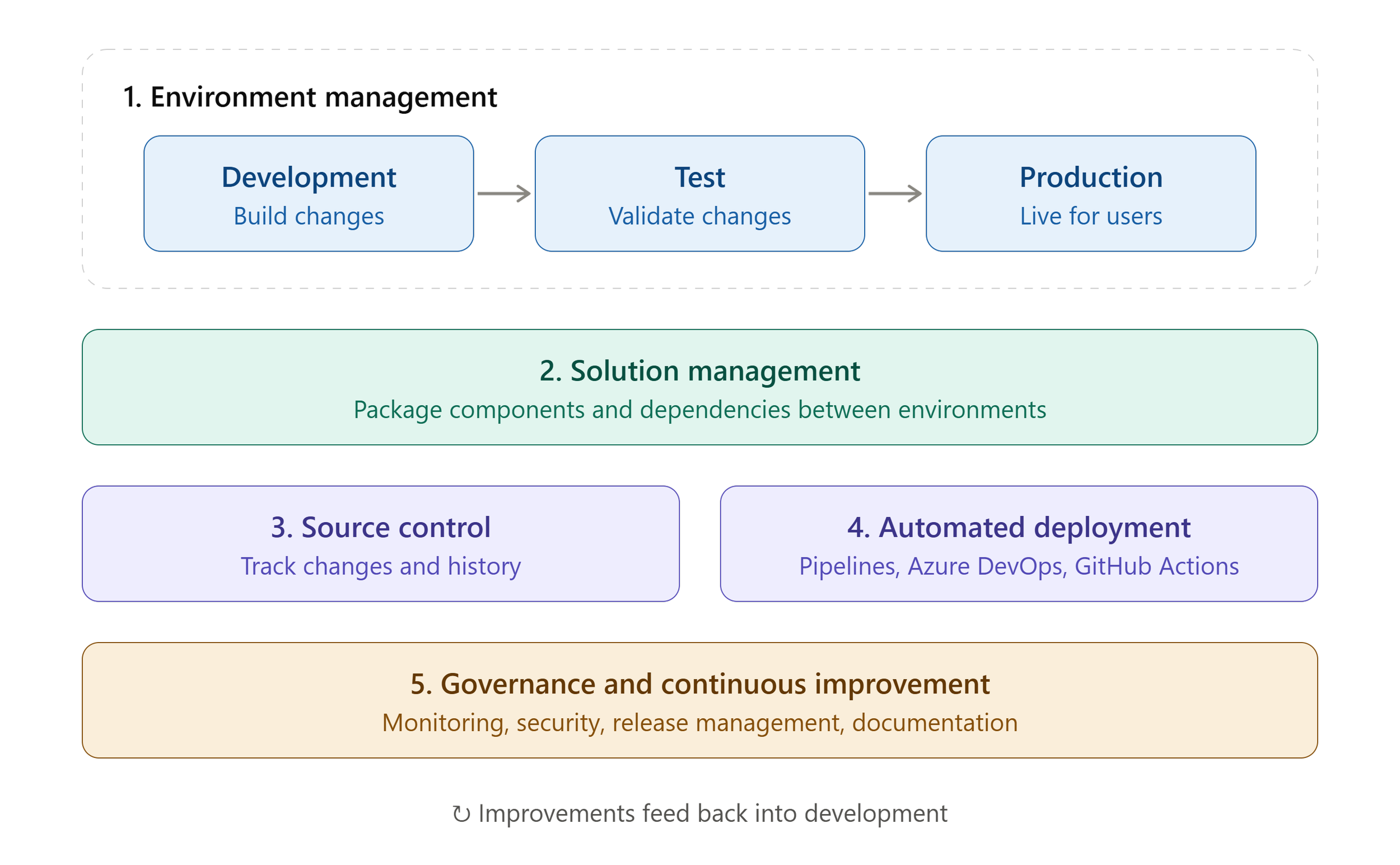
While the exact approach varies depending on an organisation’s architecture, requirements and delivery model, there are several fundamental components.
Organisations typically establish separate environments for development, testing and production. This separation allows teams to develop and validate changes without directly affecting the systems employees and customers rely on every day.
Within Power Platform, solutions provide a mechanism for packaging and transporting application components between environments. They help teams organise changes and manage dependencies across different parts of an application.
Version control provides visibility into how solutions evolve, helping development teams track changes, collaborate and maintain a reliable history of their work.
Using capabilities such as Power Platform Pipelines, Azure DevOps or GitHub Actions, organisations can introduce more consistent and repeatable deployment processes. Rather than relying entirely on manual activities, teams can automate appropriate checks and deployment steps, helping reduce human error.
ALM doesn’t stop when a solution reaches production. Monitoring, security, release management, documentation and ongoing improvements are all part of maintaining a healthy application lifecycle.
Together, these practices help organisations move away from reactive change management towards a more controlled and sustainable approach.
Why Should Businesses Care About ALM?
It’s easy to view ALM as something that sits entirely within the responsibility of developers or technical teams but the consequences of poor lifecycle management can extend far beyond IT.
Imagine a business that has invested heavily in Dynamics 365 Customer Service.
Over time, different teams introduce new workflows, integrations and customisations. Changes are made to address immediate requirements, but there isn’t a consistent process for testing, documenting or deploying them.
Eventually, a seemingly minor update introduces an unexpected issue in a business-critical process.
Suddenly, what appeared to be a technical oversight becomes an operational problem.
Customer service teams experience disruption. Internal resources are diverted towards troubleshooting. Planned improvements are delayed.
ALM isn’t simply about managing code or deployments. It’s about protecting business continuity while enabling innovation.
With the right foundations, organisations can benefit from:
Greater reliability: Changes are tested and validated before reaching production.
Reduced operational risk: Structured deployment processes help minimise unexpected disruption.
Improved collaboration: Teams work within consistent processes with clearer accountability.
Faster, more predictable delivery: Repeatable practices make it easier to introduce improvements confidently.
Long-term scalability: Solutions can evolve without becoming unnecessarily difficult to maintain.
ALM Shouldn’t Be an Afterthought
One of the most important considerations is when organisations begin thinking about ALM.; decisions made early in a project can have a lasting impact.
The way environments are structured, solutions are organised and changes are governed can determine how easily a business can scale, adapt and introduce new capabilities in the future.
As organisations expand their use of automation and AI-driven solutions, having a disciplined approach to lifecycle management becomes increasingly valuable.
Coming Next: Are Organisations Getting ALM Right?
Understanding ALM is one thing. Implementing it effectively across a real organisation is another.
This week, i’ll be speaking with TTEC Digital’s expert Kieran Mackison-Brown to explore the practical challenges organisations face when introducing ALM, the mistakes that can create unnecessary complexity and what businesses should be doing before their Microsoft projects even begin.