Just Because AI Can Do Something, Doesn't Mean It Should
Agentic AI, Responsible AI and the Contact Center Crossroads
Everybody wanted a chatbot, then everybody wanted a Copilot.
Now, everybody wants an agent.
Not an assistant. Not something that simply answers questions.
But something that thinks, acts, books appointments, processes requests, updates records, raises cases and resolves problems on behalf of customers.
And if I'm honest, the speed of that shift has been fascinating.

We've gone from "How can AI help my agents?" to "How quickly can AI replace this process?"
Somewhere between those two questions, I think we skipped an important conversation..
The Difference Between AI and Agentic AI
For the last few years, most of the AI we've become familiar with has focused on helping people do their jobs better:
Summarising conversations.
Drafting responses.
Finding knowledge articles.
Suggesting answers.
Helping advisors work more efficiently.
The human was still firmly in control, however the introduction of Agentic AI changes the conversation.
Rather than simply supporting humans, agents can now execute actions, orchestrate workflows and participate in business processes themselves.
Microsoft's broader Dynamics 365 vision increasingly positions AI agents as active participants across sales, service and operational processes.
Now don’t get me wrong, this is incredibly exciting, however it's also where organisations need to become incredibly thoughtful.
Because there is a significant difference between Helping a person do something and Doing it for them !

We've moved from AI helping people do their jobs, to AI becoming an active participant in the process itself. The difference isn't subtle. One supports a decision. The other can potentially make the decision, execute an action, and move the customer journey forward without human involvement.
At this rate, by next year somebody will probably ask if the AI can attend the steering committee and update the RAID log.
Joking aside, I think we're in danger of becoming obsessed with what AI can do before we've agreed what AI should do.
Because there is a big difference between making people better at their jobs and removing people from the process entirely.
One is augmentation. One is automation.
And the further we move towards Agentic AI, the more important that distinction becomes.
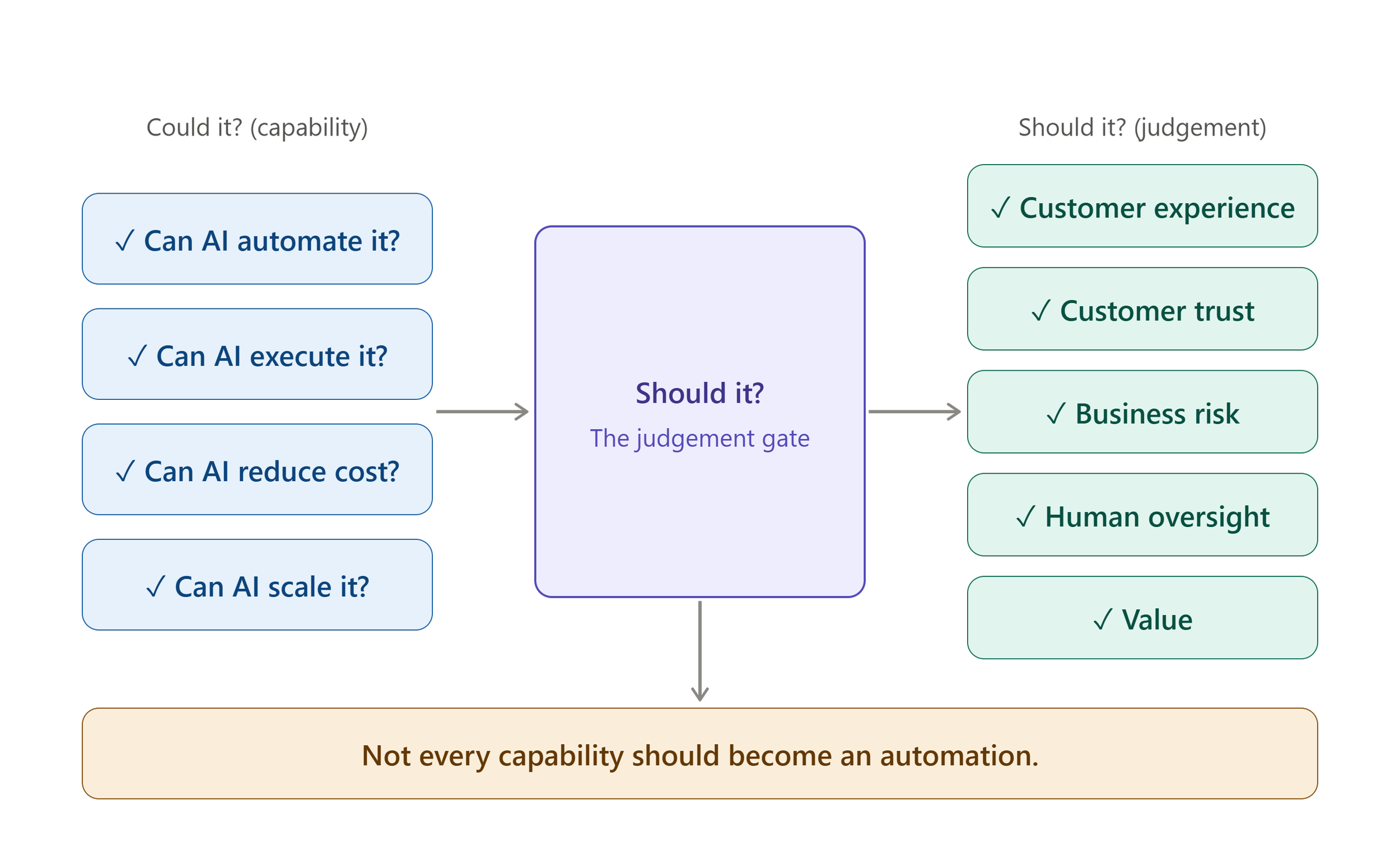
Capability is a technology conversation and suitability is a customer experience conversation and those aren't always the same thing..
Whenever Agentic AI comes up in conversation, whether it's with customers, delivery teams, or general conversations i’m having with Sales the discussion almost always focuses on capability.
Can it automate this?
Can it reduce costs?
Can it improve containment rates?
Can it replace manual effort?
Can it increase efficiency?
Can it scale customer service?
All perfectly reasonable questions; in fact, I'd probably be worried if organisations weren't asking them.
But the more conversations I am listening to the more I notice a recurring theme.
Organisations are becoming incredibly good at discussing what AI can do but not always spending the same amount of time discussing what role they actually want AI to play.
And I think that's where the most interesting conversations begin, and somewhere between capability and implementation sits a question that deserves far more attention than it often receives:
Should it?
Not because the technology isn't capable, because in many cases it absolutely is.
But because capability and suitability are not the same thing.
As organisations move from copilots and assistants towards autonomous and agentic experiences, the challenge becomes less about whether the AI can complete the task and more about whether the AI should own the experience.
Ultimately, the question shouldn’t continue to be "Can AI do it?" , the question needs to be reframed to "Is this the experience we want to create?"
And depending on the customer, the scenario and the outcome we're trying to achieve, those two answers aren't always the same.
Let's run a simple thought experiment.
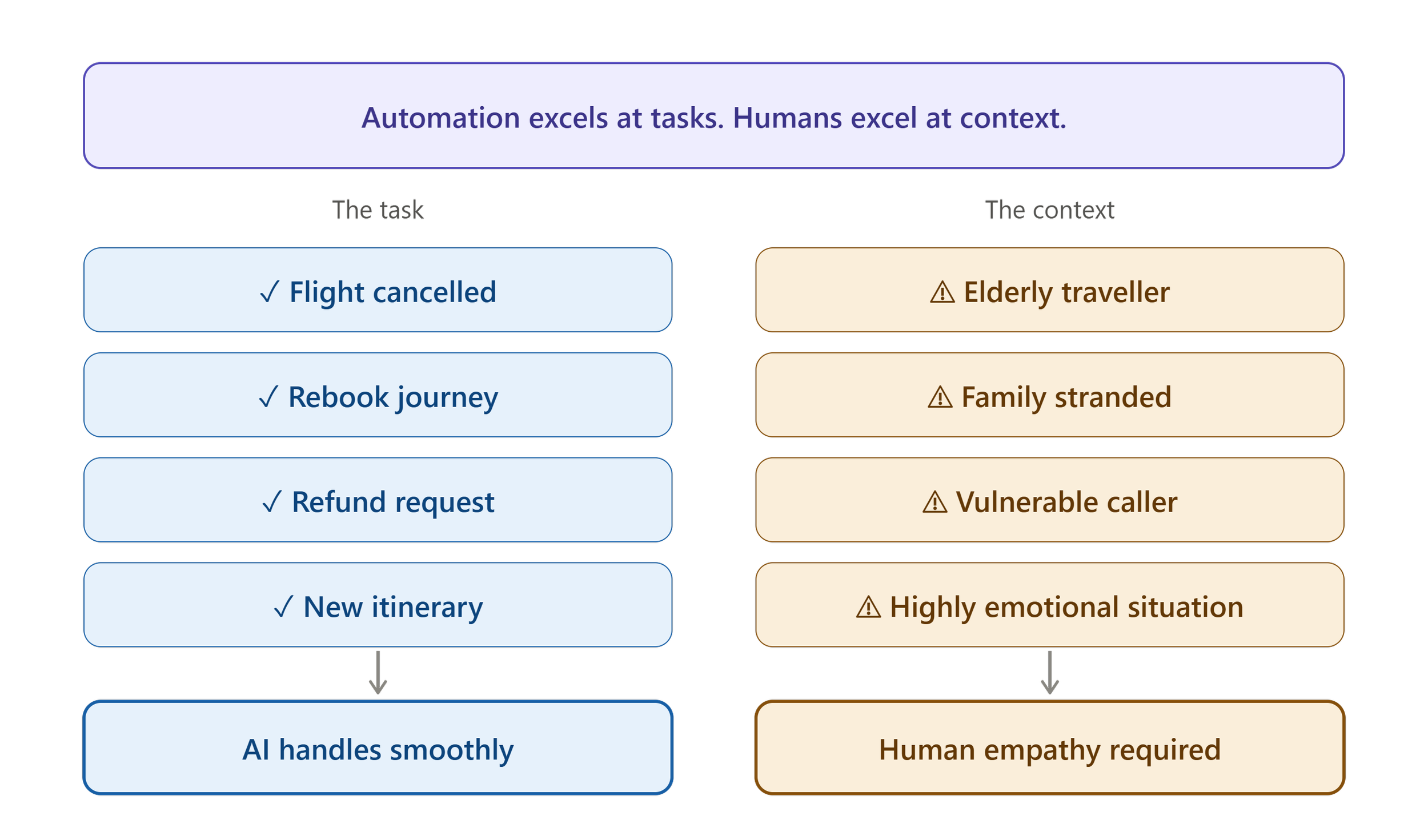
Imagine you're stranded at an airport, your flight has been cancelled.Your hotel booking is affected, your plans have disappeared and your stress levels are rising rapidly.
An AI agent could absolutely:
Rebook your flight
Find alternative routes
Arrange compensation
Process refunds
Send confirmations
Fantastic. I'd argue that's exactly the sort of scenario Agentic AI should help with.
But now let's add a little complexity.
What if:
The customer is vulnerable?
The customer is distressed?
The customer is elderly?
The customer is travelling with children?
The customer doesn't fully understand their options?
Suddenly this stops being a workflow and starts becoming a human problem.
The AI may still be capable. But is it the right experience? Because not every interaction is simply a process, sometimes it's a person.
One thing I genuinely like about Microsoft's direction is they're not positioning agents as replacements for humans.
They're positioning them as collaborators.
The future isn't people or AI the future is people with AI.
Microsoft's vision increasingly shows service representatives working alongside AI agents, quality agents and service operation agents rather than being replaced by them.
Personally, I think organisations should start with processes that are:
Repetitive, Process-driven, Rules-based, Low risk and High volume
Things like:
Appointment changes
Password resets
Balance enquiries
Order status checks
Case creation
Knowledge retrieval
These are fantastic candidates for Agentic AI because consistency matters more than empathy in these situations.
However, the types of interactions where human judgement matters most, is when Agentic Ai shouldn’t ultimately take over the entire process;
Vulnerability
Safeguarding
Complaints escalation
Significant financial impact
Complex life circumstances
Emotionally charged conversations
Then we have the topic of Responsible AI
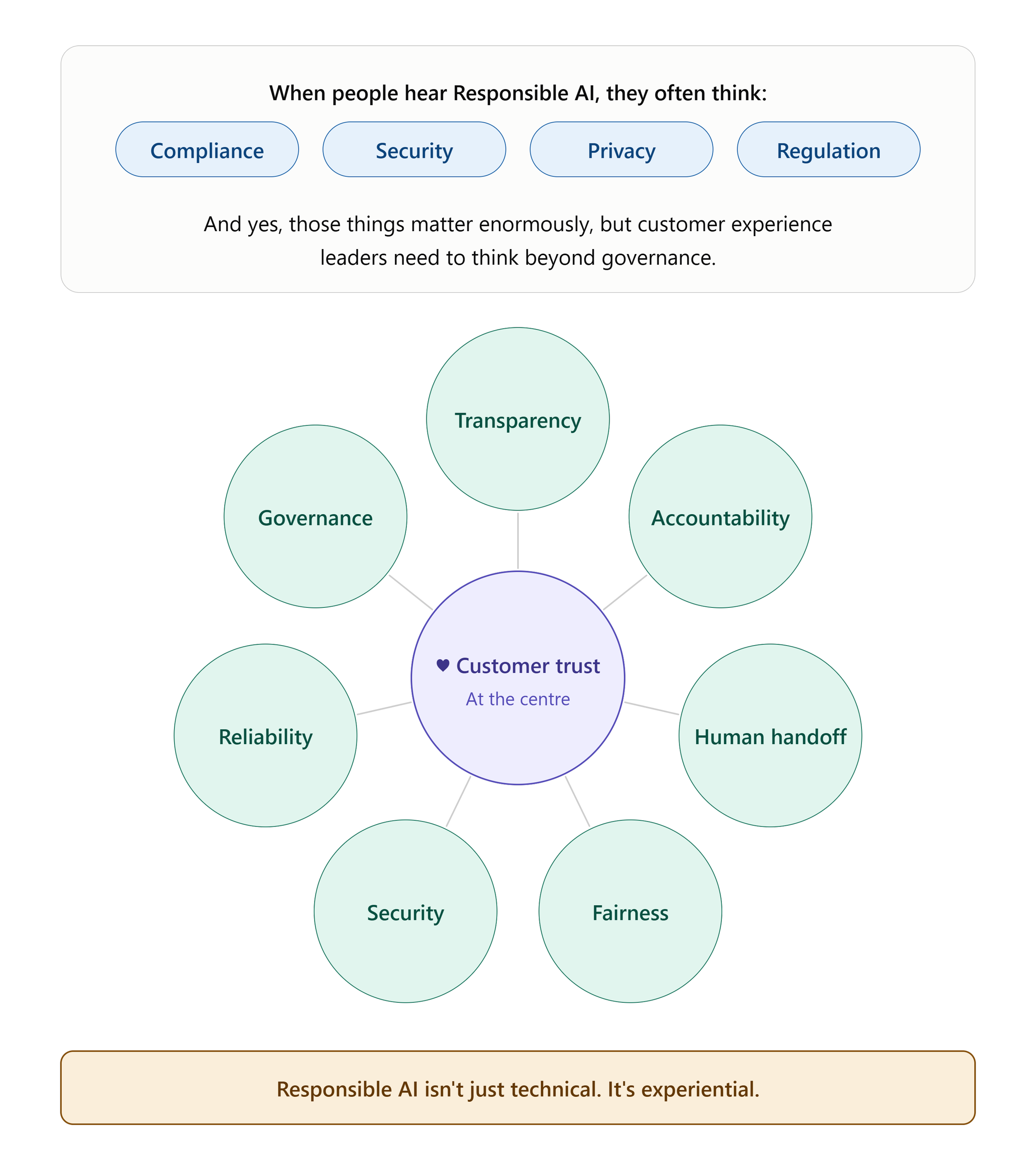
For me, Responsible AI is also a design conversation, every organisation deploying AI agents should be asking:
How will customers know they're speaking to AI?
When should AI hand over?
What level of autonomy is appropriate?
How do we avoid over-automation?
What happens when the AI gets it wrong?
Those questions are just as important as the technical architecture, because trust is part of the experience and customer trust takes a lot longer to build than a chatbot.
I genuinely believe Contact Centres are entering one of the most exciting periods we've ever seen.
Real-time voice, Agentic service, Quality Evaluation Agents, Customer Assist Agents and AI-powered operations.
But the most important thing I've seen in Microsoft's messaging is this:
The future isn't a contact centre full of AI It's a contact centre where humans and agents work together
One thing I've noticed from customer conversations, Microsoft sessions, industry events, reading release plans and speaking with delivery teams is that the conversation around Agentic AI is moving incredibly quickly.
In some cases, faster than the conversations around customer experience design.
The excitement is understandable. Agentic AI is genuinely changing what organisations can automate. We now have AI agents that can understand intent, retrieve information, execute actions, orchestrate workflows, monitor quality, assist advisors and increasingly resolve customer issues from end to end. Microsoft's vision increasingly places service representatives alongside teams of AI agents working together to deliver outcomes.
What's interesting is that many conversations quickly move towards "How quickly can we deploy agents?" long before "Have we designed the journey properly?"
AI doesn't magically fix broken experiences; If the customer journey is already confusing, AI can make it confusing faster.
If the process is already inefficient, AI can make it inefficient at scale.
But if the experience is thoughtfully designed, if the handoffs are clear, if the governance is right, if people know when to step in and when to step back, then AI becomes something incredibly powerful. Not because it replaces humans, but because it helps humans focus on the areas where they create the greatest value.
The more I see organisations exploring Agentic AI, the more I'm convinced that success won't be measured by how many agents they deploy, how many conversations they automate, or how much cost they remove.
It will be measured by:
Customer outcomes.
Customer trust.
Employee confidence.
Business value.
And all four still require judgement, which brings me back to where we started.
I don't think the future is humans or AI, I think it's humans and AI.
The organisations that succeed won't be the ones that automate the most. they'll be the ones that understand where automation creates value, where empathy still matters, and where human judgement should remain firmly in the driving seat.
Because ultimately, just because AI can take an action... Doesn't always mean it should.
And sometimes the most intelligent thing an AI agent can do is recognise that the next part of the conversation belongs with a human.