Contact Centre & Sales Alignment
One thing that still blows my mind is the amount of information available to Sales teams today. Their job isn't easy. They're responsible for building relationships, understanding business challenges, creating opportunities, managing complex buying cycles, forecasting accurately, protecting renewals, and ultimately driving revenue growth. Yet despite carrying responsibility for some of the most important customer relationships in an organisation, many salespeople are often working with only part of the picture.
Most sales teams know their opportunities, pipeline, revenue performance and forecasts. They know which deals are progressing, which accounts are due for renewal, and where they need to focus their time. But what many don't know is:
How many times a customer has contacted support this month
Whether service levels are improving or deteriorating
Whether customers are frustrated before renewal conversations begin
The reality is that in many organisations, Sales, Customer Service and the Contact Centre still operate as separate functions. Sales discusses growth, Service manages cases, and the Contact Centre handles interactions. Each team has valuable pieces of customer insight, but rarely does anyone see the complete picture.
Meanwhile, the customer experiences all three.
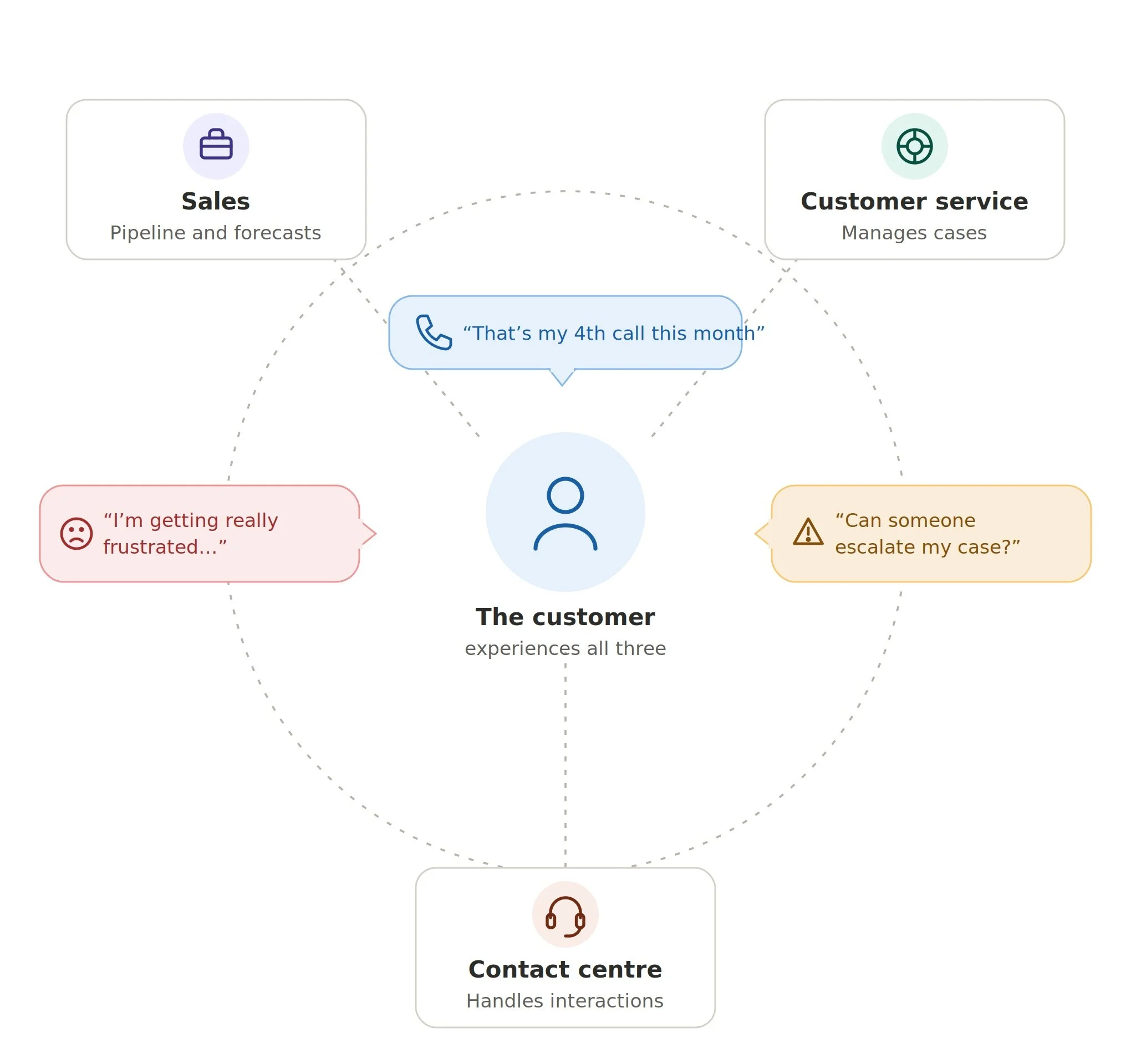
By the time a salesperson discovers a customer is unhappy, dozens of calls, emails, chats and support cases may have already told that story.
The question isn't whether the organisation has the information. It's whether it's connecting the dots quickly enough to turn service insight into stronger customer relationships and, ultimately, better business outcomes.
The real opportunity of combining Dynamics 365 Sales, Customer Service and Contact Center isn't operational efficiency.
It's creating a single view of customer reality.
Imagine a salesperson walking into a renewal meeting already understanding:
Recent service issues
Contact centre interactions
Customer sentiment
Open cases
Escalations
Suddenly customer conversations become much more meaningful.
Often the biggest threat to revenue isn't a competitor; it's an unresolved service issue nobody noticed.
So how do you actually connect those dots?
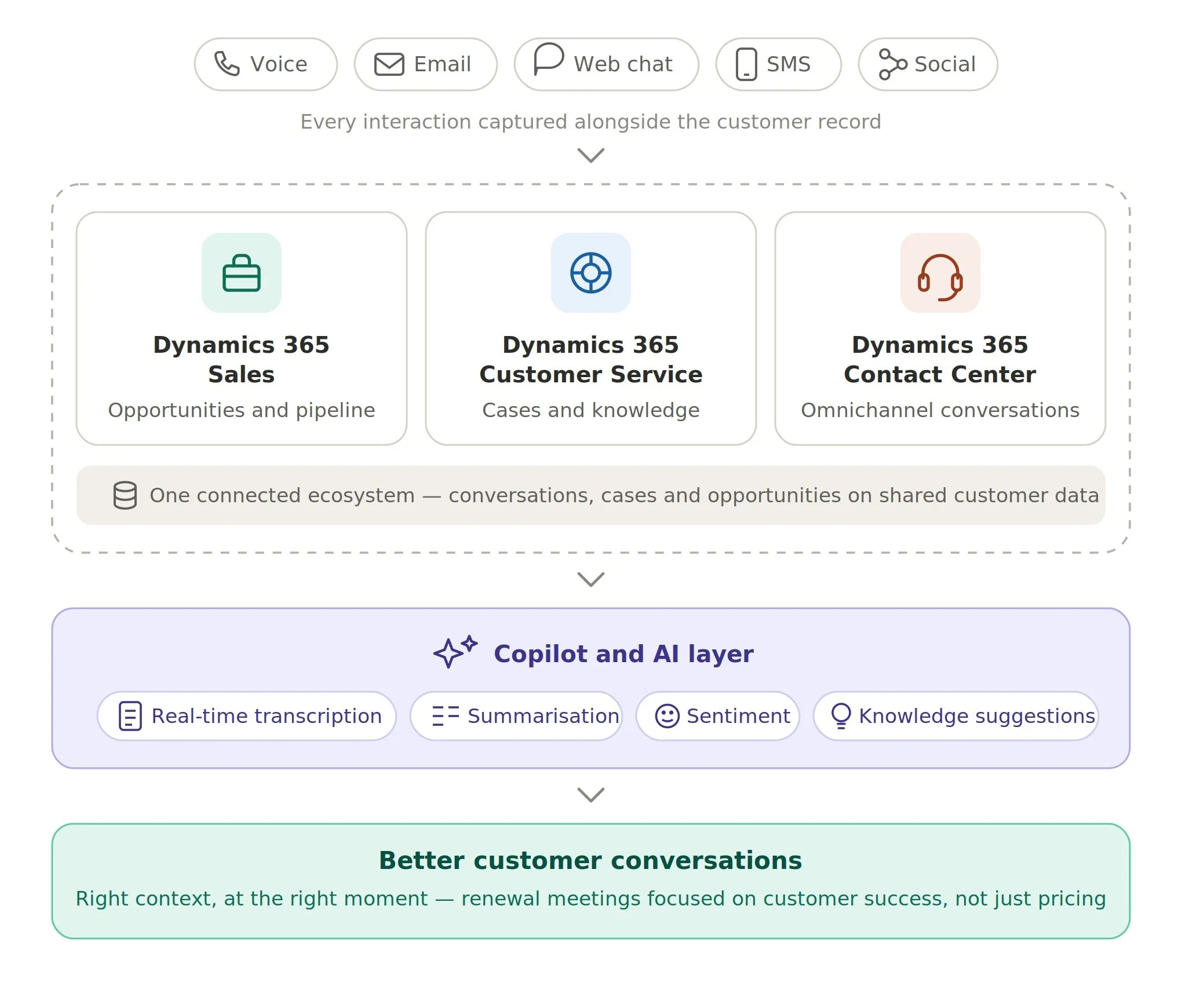
This is where the combination of Dynamics 365 Sales, Customer Service and Contact Center becomes incredibly powerful. Rather than storing customer interactions in separate systems and expecting teams to piece the story together themselves, Microsoft is bringing conversations, cases, opportunities and customer engagement into a connected ecosystem.
From a CCaaS perspective, every interaction matters. Voice calls, emails, web chat, SMS and social messaging can all be captured alongside customer records, giving organisations a much richer understanding of what's really happening within an account. Instead of a salesperson seeing only revenue and pipeline, they can gain visibility into the interactions that shape a customer's perception of the business every day.
The role of AI adds another dimension. Real-time transcription, conversation summarisation, sentiment detection and knowledge recommendations can help organisations understand not just what customers are saying, but how they're feeling. A customer who has contacted support multiple times about the same issue may still appear healthy in a sales forecast, but the service and contact centre data could be telling a very different story.
For sales teams, this creates opportunities to have better customer conversations. Imagine being able to review recent support interactions before a renewal meeting, understand which cases remain open, identify recurring issues and collaborate directly with service teams to address concerns before discussing future investment. The conversation immediately moves beyond pricing and contracts and becomes focused on customer success.
Microsoft's investment in Copilot experiences across Dynamics 365 is helping move towards this connected reality. By bringing together information from CRM, customer interactions and wider business data, sellers spend less time searching for information and more time engaging with customers with the right context at the right moment.
Perhaps the most exciting aspect isn't improved reporting or faster access to data. It's the possibility of turning service conversations into commercial insight. Every support call, email, web chat and interaction contains valuable information about customer needs, challenges and future opportunities.
When Sales, Service and the Contact Centre operate from the same customer picture, organisations are no longer simply reacting to issues; they're actively uncovering opportunities to strengthen relationships, protect revenue and drive growth.
In a world where products are becoming increasingly similar, customer experience is often the greatest differentiator.
That means the contact centre isn't just supporting the customer journey anymore.
It's helping shape the next sale.