The Customer Doesn't Care About Your Org Chart
Or your service desk structure. Or your field service team. Or the fact that three different departments own the process they're currently stuck inside.
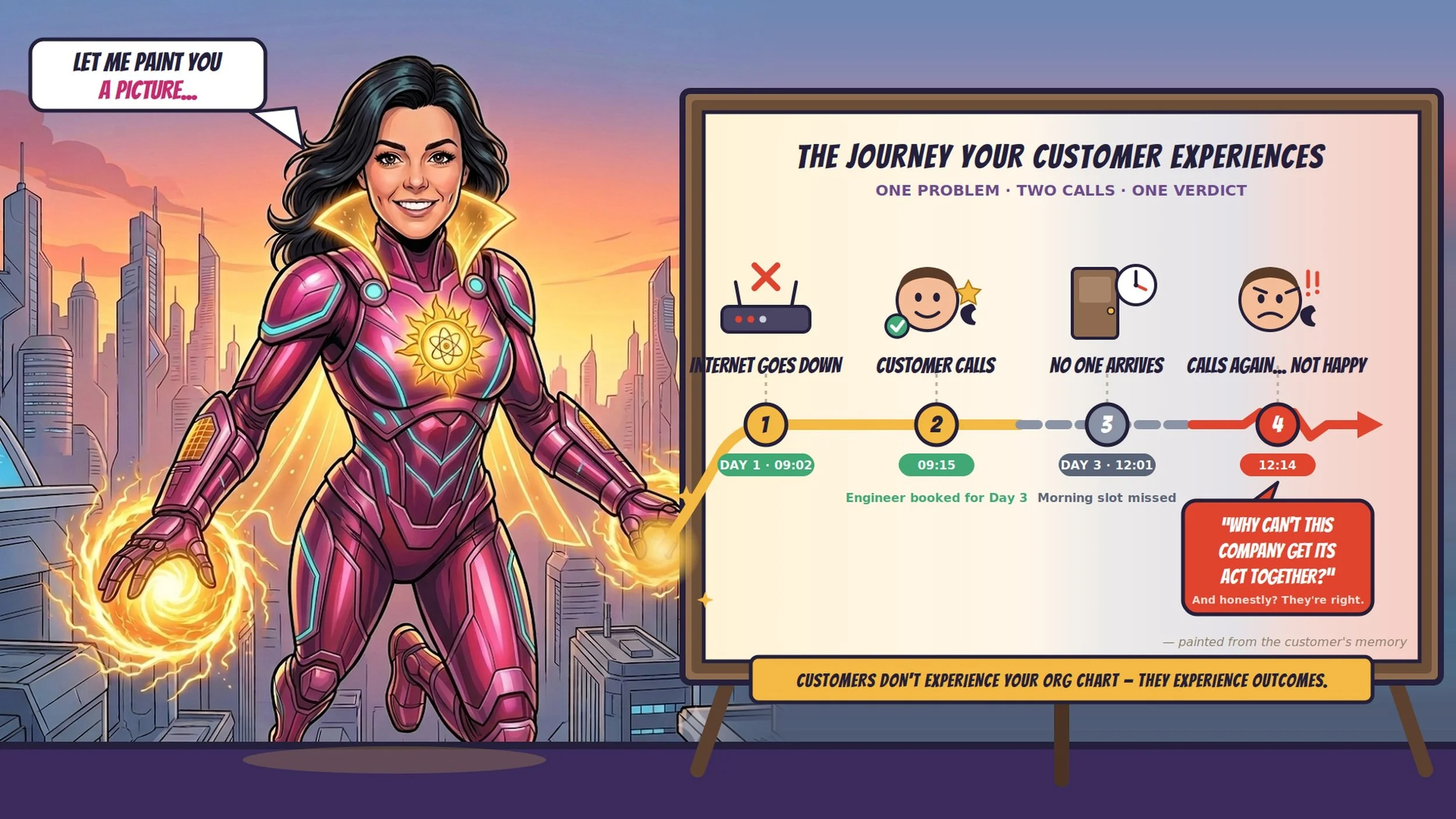
Your internet goes down.
You call the contact centre.
The advisor is brilliant.
They answer quickly. They're friendly. They understand the issue. They reassure you.
They book an engineer and leave you feeling confident that everything is under control.
So far, so good…..
Then the engineer doesn't arrive.
You call back.
The next advisor can't see what's happened.
The appointment appears to be missing.
The notes are incomplete.
You're transferred.
You explain the problem again.
Then again.
And maybe one more time for good measure.
At that moment, the customer isn't thinking:
"The contact centre did a good job."
"Field Service appears to have broken the process."
"I wonder which department owns scheduling?
"
They're thinking:
"Why can't this company get its act together?"
And honestly?
They're right.
Because customers don't experience our internal organisational structures.
They experience outcomes.
The problem wasn’t accidently created
Over the years, organisations have become very good at optimising individual departments.
We've invested in:
Contact Centres
CRM platforms
Scheduling systems
Knowledge bases
Mobile workforce applications
Asset management solutions
Field service platforms
Every single one of them solves an important problem….. Yet collectively they often create another.
😩A disconnected customer experience 😩
Because while departments may be separated internally, customer journeys aren't.
A customer doesn't stop being a customer the moment a case becomes a work order.
They don't suddenly care which system owns the next step.
The journey is still one journey. The problem is still one problem. The outcome is still one outcome.
The conversation isn't the service
One thing that fascinates me about the Customer Experience industry is how much attention we place on interactions.
Response times.
Handling times.
Containment rates.
Customer satisfaction scores.
AI capabilities.
Chatbots.
Voice bots.
Agent productivity.
And don't get me wrong. Those things matter. A lot
But somewhere along the way, organisations can fall into the trap of believing the interaction itself is the service.
It isn't.
The interaction is often just the beginning.
The customer measures success differently.
They measure success by whether the problem actually gets fixed.
This is where Dynamics 365 Contact Center gets interesting
Microsoft continues to invest heavily in Dynamics 365 Contact Center.Recent release waves have focused on:
AI-powered customer self-service
Customer Intent Agents
Copilot-driven experiences
Knowledge optimisation
Conversational IVR experiences
Autonomous issue resolution
Omnichannel engagement across voice and digital channels
as someone who spends a lot of time talking to customers about Contact Centres, I love seeing where Microsoft is taking the platform.
But here's the thing; the most impressive contact centre in the world still loses value if the problem never gets resolved and customers are left asking "Has somebody actually fixed it?"
ENTER…… FIELD SERVICE
Honestly, I think it's one of the most underappreciated parts of Microsoft's Customer Experience stack.
While Dynamics 365 Contact Center is making conversations smarter, Dynamics 365 Field Service is increasingly focused on execution. Microsoft is investing in technician productivity, scheduling optimisation, Copilot experiences, AI innovation, work order management and mobile experiences for frontline workers.
Not the conversation…The action.
Not the promise…The delivery.
Not the case…The resolution.
And those are very different things.
The real hero isn't Contact Center or Field Service
It's Dataverse….There, I said it.
Not quite as exciting as Spider-Man or marketable as Copilot. (Definitely less likely to get its own movie franchise)
But arguably far more important, because Dataverse becomes the operational fabric connecting everyone involved in the customer journey:
The contact centre advisor.
The dispatcher.
The service manager.
The engineer.
The asset.
The work order.
The customer.
Instead of passing information between disconnected systems and hoping everyone stays aligned, they're all working from the same operational dataset.
One version of the truth. One customer journey. One outcome.
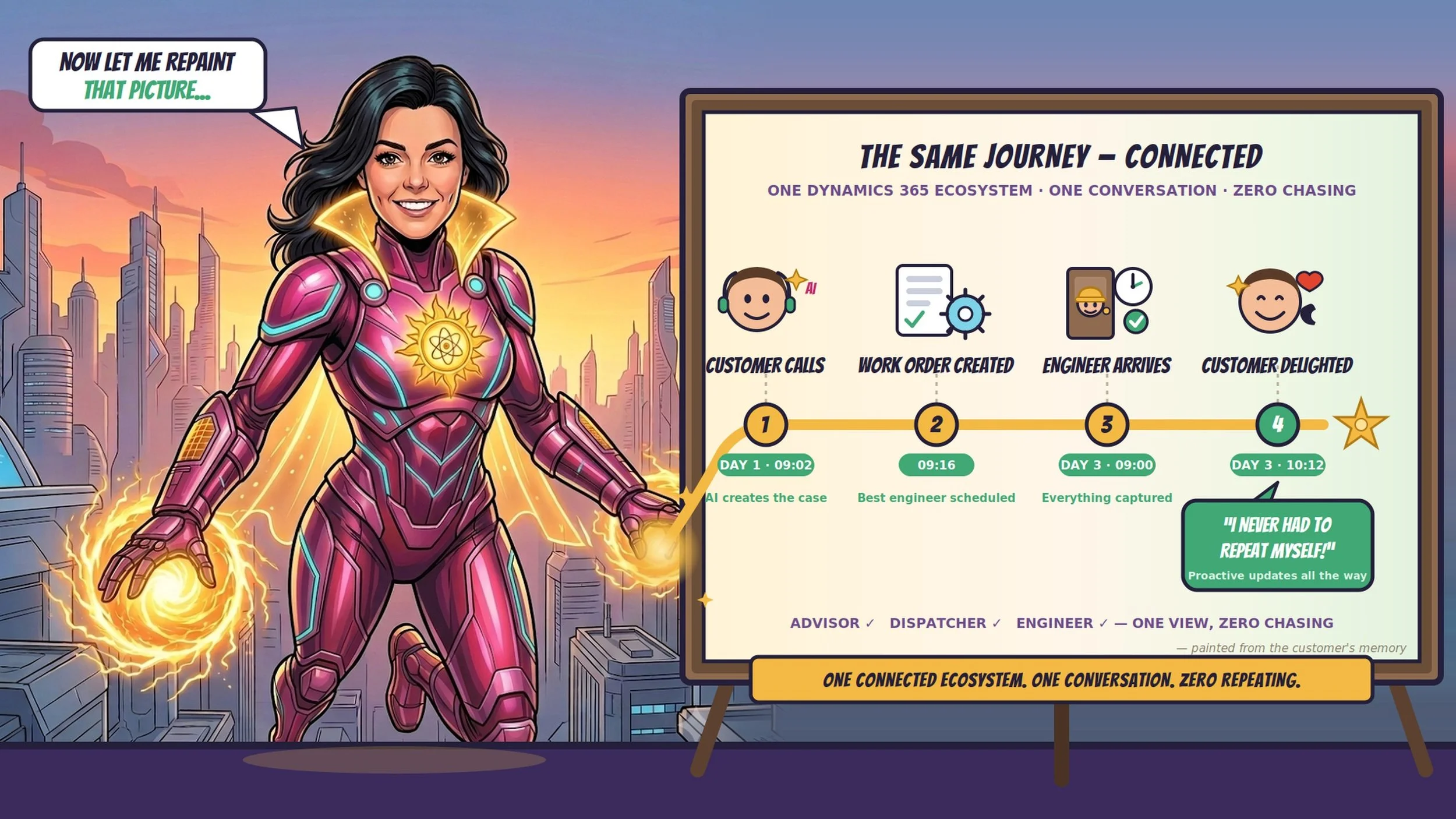
Let's revisit our broadband example.
This time using a connected Dynamics 365 ecosystem.
The customer calls.
Dynamics 365 Contact Center understands the issue.
AI identifies intent.
A case is created.
The issue requires an engineer visit.
A work order is generated.
Scheduling identifies the best available resource.
The engineer receives the assignment.
Notes, updates, completion details and outcomes are captured.
The customer receives proactive updates.
The advisor can see exactly what's happened.
The dispatcher can see exactly what's happening.
The engineer can see exactly what's required.
Nobody is calling another department to ask for an update.
Nobody is updating spreadsheets.
Nobody is sending emails to find out where the work order has gone.
And most importantly... 🥳
The customer isn't repeating themselves🥳
Why this matters more than ever
We're entering a world where AI is becoming incredibly capable. Every Microsoft release wave introduces smarter self-service, more intelligent routing, more conversational experiences, and greater levels of automation. Contact Centres will continue to get better at understanding intent, resolving simple issues, and reducing customer effort. But customer experience will still be won or lost on execution. Customers don't remember the chatbot that answered their question. They remember whether the engineer turned up. They don't remember the IVR journey. They remember whether their issue was resolved. And they certainly don't care which department owned which part of the process. They care whether somebody helped them and whether the problem got fixed.
Ironically, my favourite part of Microsoft's roadmap isn't a single feature.
It's not a Copilot.
It's not an AI Agent.
It's not a dashboard.
It's the fact that the customer journey is becoming increasingly connected.
As Dynamics 365 Contact Center and Dynamics 365 Field Service continue to evolve on the same platform, supported by Dataverse, the handoffs between teams become less visible and the experience becomes more seamless. The customer doesn't see a contact centre team, a scheduling team and a field service team. They see one organisation helping them solve a problem.
And that's the part that excites me most.
Because from a customer's perspective there shouldn't be a handoff between Contact Center and Field Service.
There should simply be:
A problem.
A journey.
A resolution.
And if we're serious about customer experience, that's the loop we should all be trying to close.
Because at the end of the day...
The customer doesn't care about your org chart.
They just want the problem fixed.🚀